WattNext Insights
Heroes, Blockers and Ghosts: Why Good People Leave Quietly
Hidden contributors, approval bottlenecks and quiet withdrawal: how leaders can uncover the work their organisation relies on.
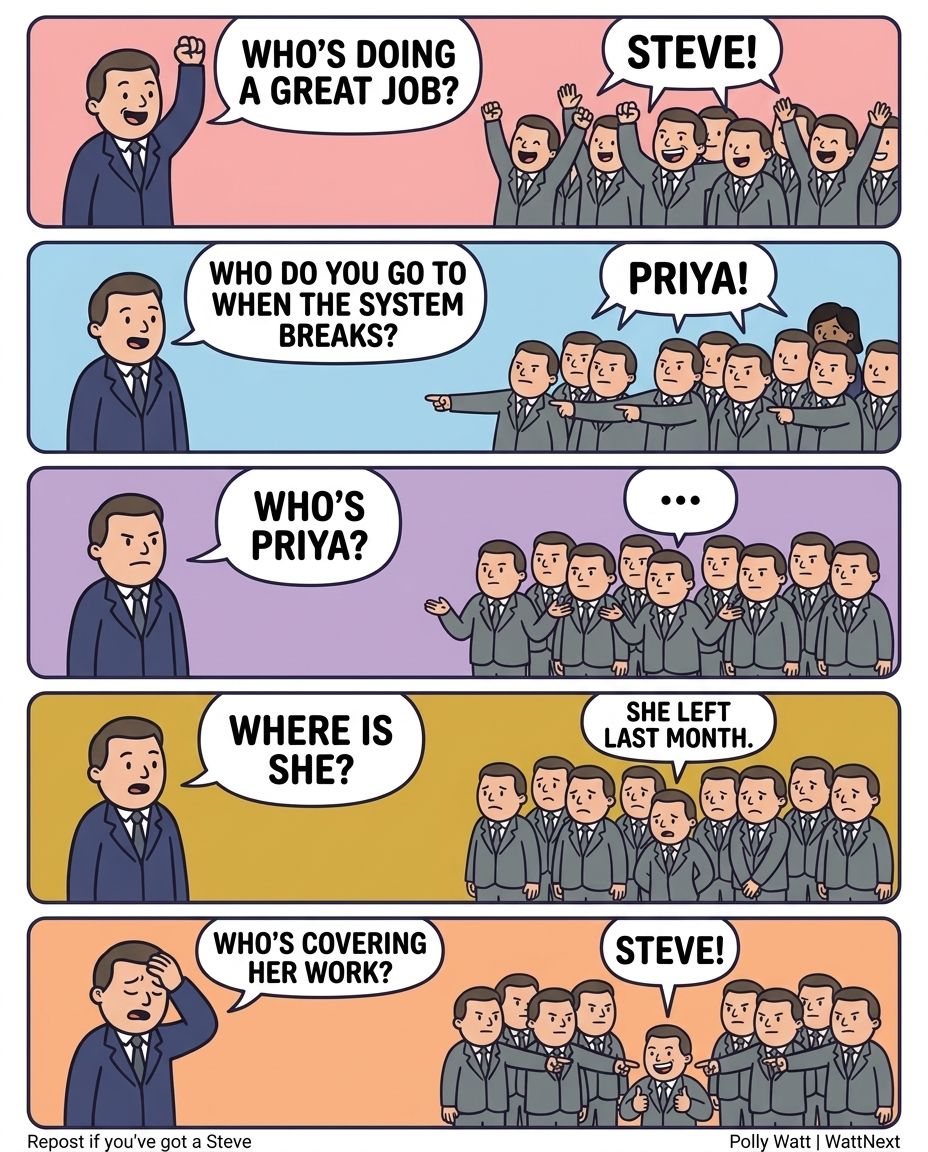
By Polly Watt
Good people leave quietly. Blockers stay loudly.
The resignation lands and everyone says the same thing: “We had no idea.”
But somewhere in the organisation, people knew. They saw who kept fixing the handovers. Who translated the confusing decisions. Who had stopped suggesting improvements. Who everybody worked around.
The information existed. It just never reached the people making the decisions.
In my LinkedIn post on heroes, blockers and ghosts, I described three patterns that can help leaders see this more clearly. They’re deliberately memorable. They aren’t personality types or a scientific classification of employees.
They’re a way to ask a harder question: what does your organisation depend on that your leadership team cannot see?
The practical takeaway Make hidden work visible. Investigate repeated delays. Ask what changed when someone stopped contributing. Then repair the conditions behind those patterns. The aim is to make good work sustainable, with clear ownership and enough support that nobody has to rescue the same process every week.
The hero: the person holding the gaps together
The hero knows how things actually work.
They know which document is current, who can resolve the customer problem, and why the official process stalls at step four. When a new colleague gets stuck, someone says, “Ask her. She’ll know.”
They connect teams that don’t communicate. They explain decisions they didn’t make. They notice the unfinished work and quietly finish it.
Some of this is exactly what good collaboration looks like. Organisations need generosity, judgement and people who help one another.
The problem starts when that generosity becomes an unacknowledged operating requirement.
Imagine a project coordinator who spends every Friday repairing incomplete handovers between sales and delivery. This is an illustrative example, but the distinction matters: her job description says coordination. Her actual contribution includes preventing disappointed customers, resolving ownership disputes and teaching colleagues what the process leaves out.
Her performance review measures the projects she completed. It doesn’t measure the failures she prevented.
Then her own deadlines slip. Leadership sees a time-management problem. She sees another evening spent absorbing somebody else’s unfinished work.
Research on collaboration has been raising this concern for years. In their 2016 Harvard Business Review article, Rob Cross, Reb Rebele and Adam Grant reported that time spent on collaborative activities had grown by 50% or more over the preceding two decades. That is historical research, not a current estimate, but it helps explain why helping others deserves attention as workload. Source: Collaborative Overload.
If replacing that person simply creates a vacancy for the next exhausted hero, you haven’t solved the retention problem.
You’ve restarted it.
The blocker: the person everything has to pass through
The blocker appears essential because work cannot move without them.
Every approval comes back to their desk. Information arrives late. Routine decisions need a meeting. Colleagues develop unofficial routes around the official route.
From above, this can look like control and expertise. From below, it can feel like trying to get through a locked door.
But “blocker” is where this framework needs the most care.
A colleague challenging a risky decision may be doing their job well. A finance approval may exist for a good reason. Someone who asks difficult questions is not automatically obstructive.
And a bottleneck may have been designed into the role.
In the discussion beneath my post, Andrew H. pointed to unclear decision rights: when nobody knows who has authority, someone can become the informal gatekeeper. Valorie Robles added a useful distinction between the person carrying the work and the person controlling it. Both comments move the discussion towards organisational design. Source: the original discussion.
Before deciding someone is the problem, establish what is happening:
- Which decision or handover repeatedly stops?
- Who has formal authority to move it forward?
- What information or capacity is missing?
- Which checks protect quality, and which merely duplicate another check?
- Does the same delay occur when someone else performs the role?
You may find deliberate information hoarding. You may find an overloaded manager with no deputy. You may find five teams making contradictory demands.
Those require different responses.
Repeated accounts of the same delay justify investigation. They don’t, by themselves, establish motive or justify a personnel decision.
The ghost: when someone stops offering what they once gave
The ghost is easy to miss because their work may still look acceptable.
They attend. They deliver. They respond when asked.
What has disappeared is the contribution that used to come voluntarily: raising the awkward issue, improving the process, helping a new colleague, offering an idea before somebody requested it.
The change is the signal.
Working your contracted hours is not disengagement. Declining extra work is not evidence of a bad attitude. Sometimes it is a sensible response to an unreasonable workload.
Nor can a manager infer someone’s motivation from silence. Health, caring responsibilities, confidence, working preferences and circumstances outside work can all matter.
But if someone used to contribute ideas and no longer does, it is worth understanding what changed.
Perhaps their suggestions went unanswered. Perhaps speaking up brought consequences. Perhaps helping became the easiest way to acquire more work without more authority or recognition.
Ask about that history before asking for more enthusiasm.
Gallup’s State of the Global Workplace 2026 reports that 20% of employees globally were engaged in 2025. Manager engagement fell from 27% in 2024 to 22% in 2025. Those figures describe Gallup’s engagement measures; they do not tell us how many people are “ghosts”, or explain any particular employee’s behaviour. Source: Gallup.
They do remind us to include managers in the conversation. The person expected to notice everyone else’s withdrawal may be struggling too.
How the three patterns can reinforce each other
Consider a team where routine approvals have become slow.
A helpful colleague learns how to push urgent work through. Everyone begins going to her. Customers remain happy, so leadership sees little reason to change the process.
Her rescue work grows. The official approval route remains slow. Eventually, she stops volunteering, asks to move teams or leaves.
Only then does the organisation discover how much depended on her.
This is a hypothetical sequence, not a claim that every resignation follows the same path. It illustrates why looking at the three patterns together is useful.
| What leadership sees | What may be happening | What to investigate |
|---|---|---|
| Work gets delivered | Someone repeatedly repairs failed handovers | Rescue work, time spent and formal ownership |
| One person is indispensable | Knowledge or authority is concentrated | Access, delegation and backup coverage |
| Fewer complaints | A problem improved, or people stopped raising it | What changed and whether speaking up leads to action |
| Stable headcount | People stayed, but capacity or confidence declined | Workload, contribution and employee accounts |
None of the right-hand explanations should be assumed. They are hypotheses to check with the people doing the work.
Why an engagement score may miss the mechanism
An engagement score can flag a problem without explaining how the work produces it.
“Do you feel supported?” is useful. So are questions about recognition, workload and trust. Well-designed surveys can include open questions and questions about working relationships.
The limitation is treating a summary score as a complete explanation.
Two teams can give the same answer for different reasons. One lacks capacity. Another has enough people but cannot make decisions. A third has a manager protecting everyone from a broken handover at considerable personal cost.
Each needs a different intervention.
Ask people to describe a recent event:
“When work last got stuck, what happened next?”
That gives you a sequence to investigate. Who needed what? Where did the delay occur? How did it get resolved? Did the solution depend on somebody working around the process?
Then compare the accounts across roles. Leadership may describe a clear approval process while employees describe several competing versions of it.
That gap is useful evidence. It gives you something specific to resolve.
Six questions to ask before the resignation arrives
Start with a real piece of work and follow it through the organisation. These questions help reveal the contribution, friction and uncertainty hidden inside it.
- When the normal process fails, where do you go for help? Ask what help is needed and why the normal route cannot provide it.
- What gets done only because somebody remembers, chases or intervenes? Look for recurring work that has no recognised owner.
- Where does work wait, and what is it waiting for? Separate a necessary check from missing information, capacity or authority.
- Who owns this on paper, and how does it actually happen? Compare the intended process with recent examples.
- What have you stopped suggesting or doing, and what changed? Give people room to explain without treating extra effort as an obligation.
- What would become difficult if the usual helper were unavailable? Look for dependencies that need backup, documentation or a clearer decision rule.
Explain how the answers will be used and who will see them. Report themes with enough context to act, while protecting contributors from being identified through their examples.
A popularity contest will tell you who is visible. A careful examination of real work can tell you what the organisation relies on.
What should leaders change first?
Choose one repeated problem with a clear owner and a change you can test. People need to see that describing the problem leads somewhere.
For hidden rescue work, make the work visible in capacity planning. Remove competing demands. Recognise the contribution in performance conversations, and give knowledge-sharing an actual allocation of time. “Please document everything” is another task unless something else comes off the list.
For approval delays, specify who can decide, within what limits, and where unusual cases go. Keep necessary checks. Test whether routine decisions can happen closer to the work.
For withdrawal, start with a private conversation about what changed. Listen to the answer before proposing a motivation programme. Follow through on a specific commitment you can keep.
A practical first month might look like this:
- Week one: Gather examples across the roles involved and establish the current problem.
- Week two: Check the pattern against available records and agree one change with an accountable owner.
- Week three: Put the change into practice and make the new route clear.
- Week four: Ask what improved, what still gets stuck and whether the burden moved elsewhere.
This is a suggested test cycle, not a promise that retention improves in 30 days. Early measures could include approval times, rework, unplanned rescue work and whether people know who can make the decision. Retention takes longer to assess and has many causes.
Questions leaders often ask
Can the same person be a hero and a blocker?
Yes. Someone may generously support colleagues while keeping knowledge or decisions concentrated around themselves. Study the behaviour and its effects in context. The framework becomes less useful the moment a label replaces curiosity about what someone does, why they do it and what the role requires.
Should we ask employees to name the blockers?
Start by asking about events, work and decisions. Requests to identify “blockers” invite personal judgements before you understand the process. Where accounts involve individuals, handle them carefully, seek context and use a fair process. Recurring friction is an organisational signal to investigate, not a public ranking of colleagues.
Can listening prevent every resignation?
No. Pay, career opportunities, personal circumstances and job fit all matter. Listening can help leaders find avoidable problems earlier, provided they act on what they learn. It cannot guarantee that someone will stay, and finding a process problem does not prove it caused a particular departure.
Find the work your organisation has learned to hide
Your next retention conversation could begin with the handover that always needs rescuing. The approval everyone works around. The colleague whose suggestions have quietly stopped.
Follow one of those threads far enough and you may discover a very different organisation from the one on your chart.
At WattNext, this is the purpose of organisational intelligence: helping leaders understand how work is experienced across the organisation, so they can act on recurring friction and gaps in understanding.
Start with one question this week: “What keeps working here only because someone keeps rescuing it?”
Then make sure the answer changes something.